32 Soulful Dark Boho Living Room Ideas to Layer Up
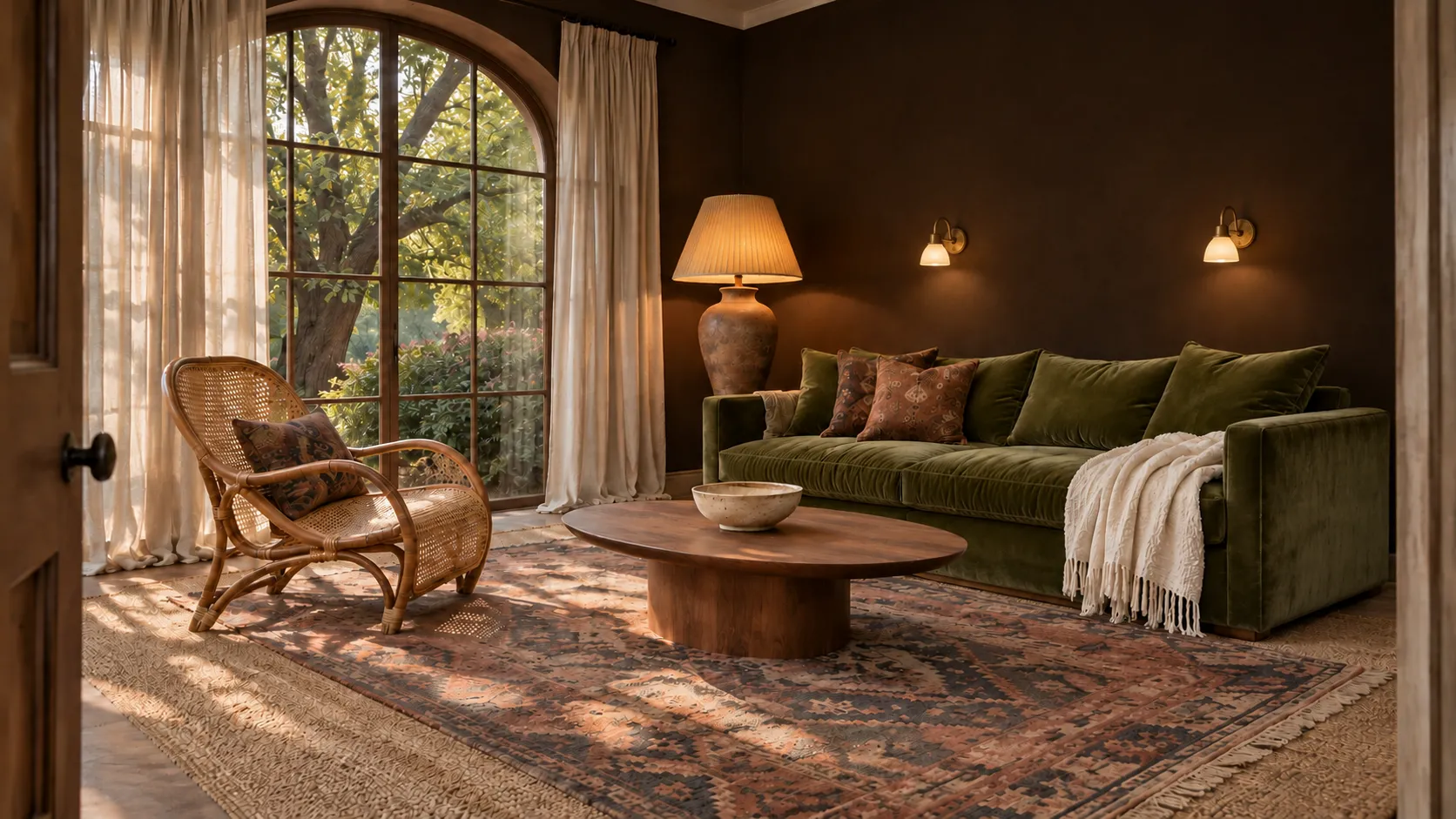
By day, you can see every stitch in your favorite quilt. By evening, the sofa, rug, and walnut table can blur into one dark shape. A dark boho living room feels cozier when a few details still catch your eye after sunset.
That’s where layering helps. Cream fringe stands out against espresso paint. A rust kilim gives the coffee table a warm outline. An ochre lampshade casts just enough light to read the last few pages of your book.
These 32 ideas will help you decide where to use color, which textures to pair, and how to give pieces you already love a place in the room. Start with the spot that feels unfinished, whether it’s the blank wall above your sofa or the corner where you’ve always wanted to sit with your tea.
Espresso Brown Walls

The cream fringe on a throw almost glows against an espresso wall. That contrast gives a dark boho living room depth, even if most of your furniture is brown. For a starting shade, look at the darkest streak in a walnut tabletop or the edge of a well-worn leather chair.
Paint a sample on a large piece of card and prop it behind your sofa. Check it in daylight and again with your usual lamps on. If the brown turns reddish beside your upholstery, test a more neutral espresso before you commit to the whole wall.
Layered Kilim Rugs

- Give a small kilim more presence by laying it over a larger, tightly woven jute rug.
- Choose a base wide enough for both front sofa legs to sit comfortably on it.
- Pull the kilim toward the sofa until a full row of its motifs shows beyond the coffee table.
- Use a thin rug pad designed for rug-on-rug placement if the top layer shifts underfoot.
An open coffee table base lets you see the kilim through the legs, so even a small piece can carry the seating area. With a solid trunk or ottoman, shift the kilim slightly to one side. A broad strip of pattern beside the table shows off the weaving better than four narrow slivers.
Pleated Ochre Lampshade

Quick Tip:
Can you see the bare bulb from your favorite seat? Sit down before you settle on a shade. Its lower rim should hide the bulb while the open bottom lets light fall across your book.
Ochre linen has two distinct looks in the same room. By day, the folds bring a small patch of golden color to a dark corner. After sunset, the raised edges catch the light and the creases deepen to amber. Choose a pale lining if you often read beside the lamp.
Indigo Quilt Wall Hanging

BEFORE: A small print seems to float above a long sofa. From the doorway, your eye catches the blank wall around it, and the fine details disappear.
AFTER: An indigo quilt fills about two thirds of the sofa’s width. Its broad patches of blue read clearly from across the room, while the hand stitching gives you something to appreciate up close.
To find the hanging height, have someone hold the quilt above the sofa while you sit back. Leave enough room for your head to clear the fabric. A rod slipped through a sewn sleeve supports the top edge evenly and keeps the quilt from sagging between two hooks.
Plum Velvet Pillows

- Wake up a brown sofa with one square velvet pillow in a ripe plum shade. Set it where daylight reaches the seat.
- Place a smaller linen lumbar pillow partly in front. Look for a narrow purple stripe that picks up the velvet color.
- Turn the velvet pillow half a turn and step back. Choose the direction that brings out the richer plum tone in your light.
The difference in texture does most of the work here. Velvet looks lighter where you brush the pile, while linen keeps its matte finish even in direct sun. On a compact sofa, keep the pair at one end so there’s still room to stretch out with a book.
Carved Wood Coffee Table
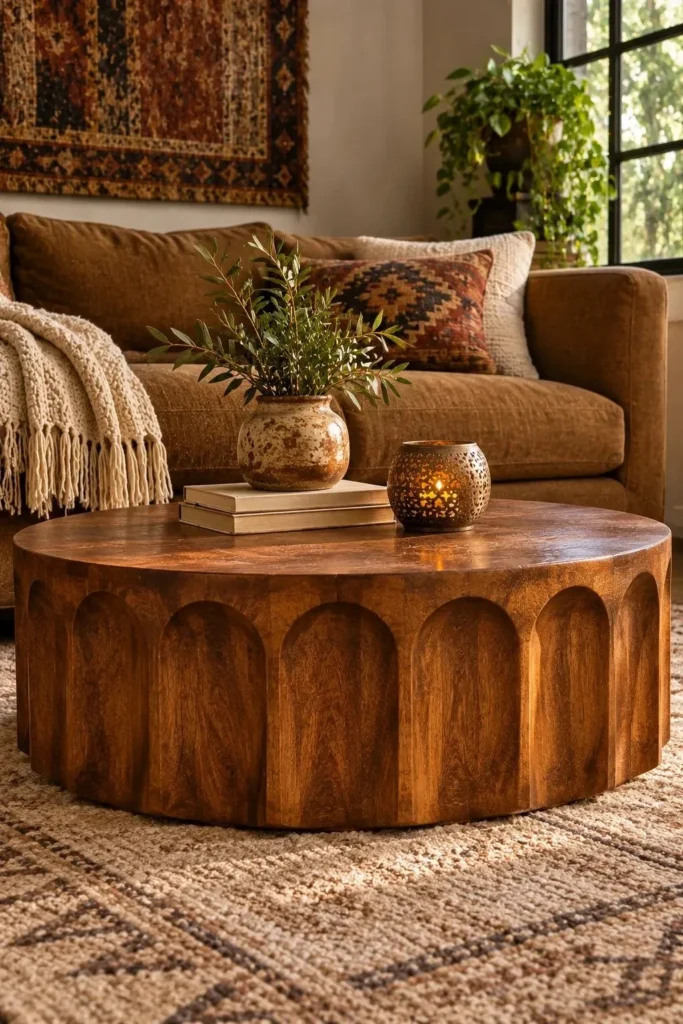
| Design detail | Carved drum table | Open-leg carved table |
|---|---|---|
| What catches the eye | Deep scallops cast shadows around the curved base. | Turned legs frame small glimpses of the rug. |
| Best rug pairing | Plain wool makes the carved outline easy to see. | A patterned flatweave shows through the open base. |
| Everyday cleaning | A solid base that meets the floor keeps stray toys from rolling underneath. | Space between the legs gives a vacuum head room to pass. |
Before choosing a finish, bring a wood sample or a close-up photo beside your sofa. A honey brown table draws out the warm flecks in charcoal upholstery. For a room that already has several wood tones, repeat one you own and let the carved profile supply the contrast.
Woven Cane Cabinet Fronts

DO
- Let pale cane break up a run of dark furniture where the sofa, cabinet, and floor are all close in color.
- Choose a tight weave for doors that hide everyday clutter.
- Check that each panel sits snugly in its frame before buying a secondhand piece.
DON’T
- Don’t push a cabinet door open by pressing on the cane.
- Don’t place bright packaging directly behind an open weave, where the colors can show through.
- Don’t crowd the top with small baskets that compete with the pattern on the doors.
Stand across the room before deciding what belongs on top. If the cabinet fronts are the first thing you notice, one broad ceramic bowl may be all they need. Its smooth surface gives your eye a place to rest, and you still have somewhere to drop your keys.
Moss Linen Curtains

Light effect: Sunlight brings out olive tones in the folds of moss linen.
Best placement: A window beside a reading chair where you can see the fabric up close.
Length: A hem that just clears the floor makes daily opening and closing easier.
Privacy: Choose lined panels if the window faces neighboring homes.
Hold a linen swatch across the window, then fold half of it back on itself. The single layer shows the color you’ll see when the curtains are closed in daylight. The doubled edge gives you a better idea of the deeper green you’ll see when the panels gather at either side.
Hammered Copper Tray

A hammered copper tray gives a soft ottoman a firm spot for your evening tea. Against charcoal wool, the little dents catch light even when most of the room is in shadow. Choose a tray with a flat center so your mug sits level inside the textured rim.
Set the empty tray where you usually reach for your drink, then press lightly on opposite edges. If it rocks on a tuft or button, shift it onto a flatter patch. Leave one side of the ottoman clear so there’s still room to put your feet up.
Saddle Leather Pouf

- A low leather pouf can turn the end of your sofa into a chaise for the evening. Choose one you can move with one hand.
- Measure from the floor to the top of your sofa cushion. For a footrest, look for a pouf that sits a little lower.
- Pick smooth leather if your rug has a busy pattern. On a plain rug, contrast stitching gives the seating area a little detail.
- Check the filling on a secondhand pouf. A zippered base lets you top it up if the center has started to slump.
Saddle brown earns its place beside cooler colors. Against navy upholstery, you can see the copper tones in the hide, especially where the top has softened with wear. Pull the pouf close enough that your knees stay slightly bent when you settle in with your feet up.
Bronze Arched Mirror

Quick Tip:
What will the mirror reflect from your favorite seat? Have someone hold it in position while you sit down, then shift it until the glass frames a leafy branch or a slice of window.
A slim bronze rim draws a fine line against a plum or charcoal wall. Its curved top also breaks up the straight edges of a console, books, and window trim. Once you like the reflection, mark the arch’s highest point with painter’s tape before measuring for the hanging hardware.
Clay Bookshelf Backs
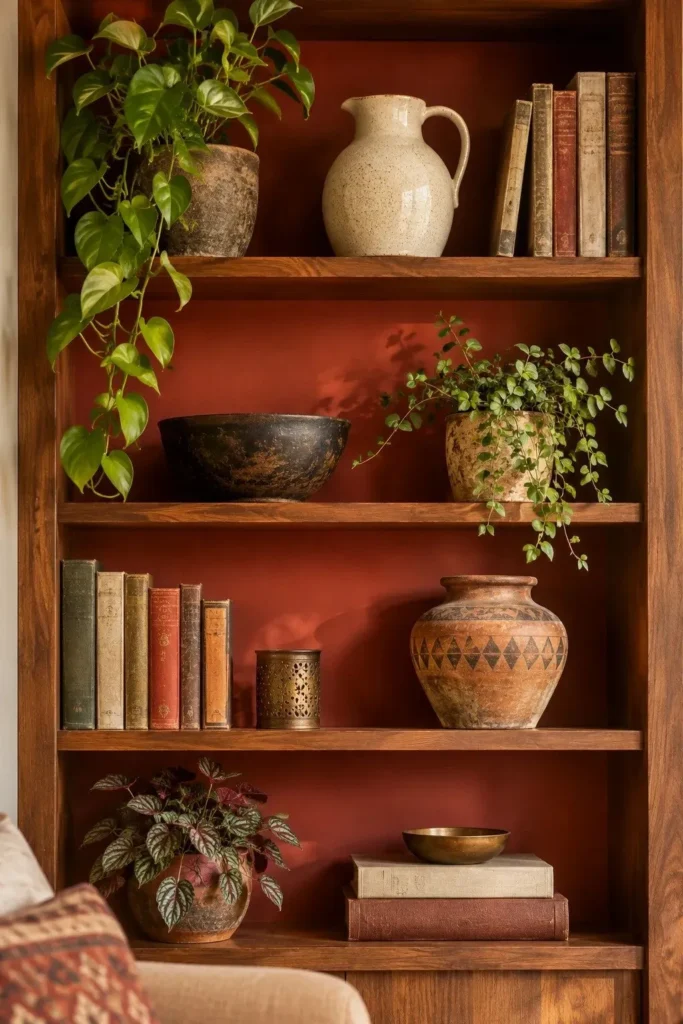
BEFORE: A black pottery bowl almost disappears at the back of a walnut shelf. From across the room, its curved lip blends into the dark wood grain.
AFTER: A muted clay panel behind the bowl makes its outline easy to see. The exposed walnut shelf above and below gives the warm color a natural boundary.
For a reversible version, cut a piece of mat board to fit one shelf opening and paint it with a sample pot. Let it dry flat before slipping it behind your pottery. Test that single panel after sunset, when lamplight can make a dusty terracotta look distinctly orange.
Trailing Pothos Shelf
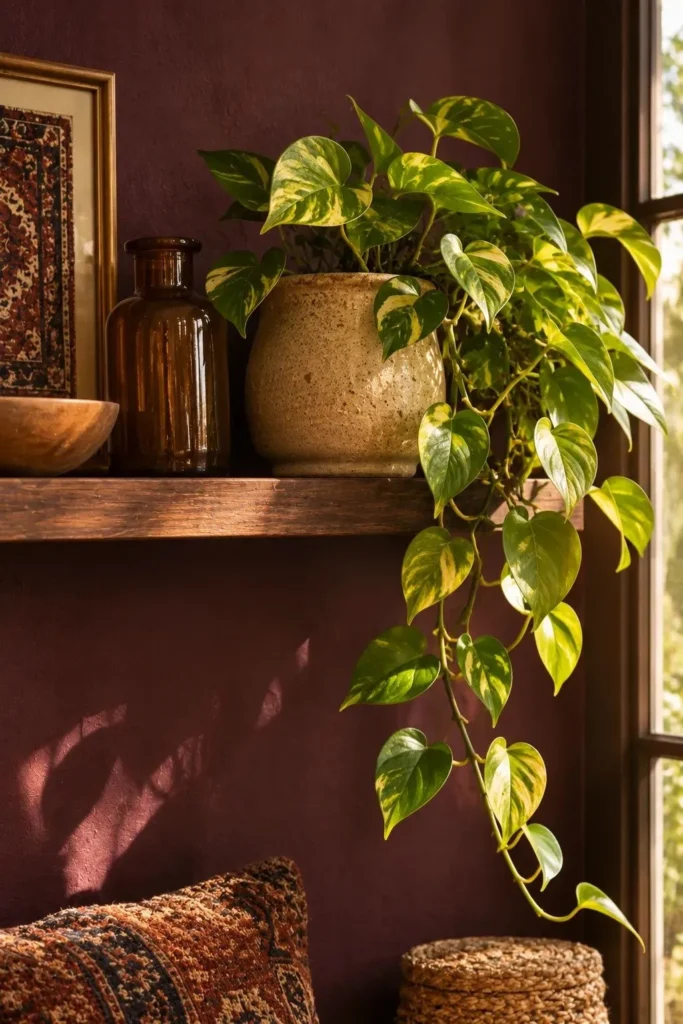
- Give one long vine the end of a shelf so its leaves show against the painted wall. Choose a spot with bright, indirect daylight.
- Slip the nursery pot into a watertight planter. Leave enough room above it to lift the plant out for watering.
- Guide the longest stem over the outer edge and let a shorter one curl across the wood. Move nearby objects clear of the growing tips.
A dark wall makes the yellow markings easy to see, so a single plant can give an otherwise bare shelf enough color. Take the inner pot to the sink for watering and let it drain before putting it back. That small routine keeps moisture rings off the wood.
Woven Rattan Pendant

| Design detail | Open lattice shade | Tightly woven shade |
|---|---|---|
| Evening effect | Gaps in the weave let bands of light reach the wall. | A broad lower opening directs more light toward the tabletop. |
| View from the sofa | The bulb is visible between the strands. | Dense sides screen the bulb from seated guests nearby. |
| Best placement | Beside a plain wall where the shadows have room to show. | Above a game table where you want to see the cards clearly. |
Check the shade from the seat you use most. A pendant that looks soft from the doorway can put a bright bulb directly in your sightline once you sit down. With an open weave, a frosted bulb softens that bright point and still lets the rattan pattern show.
Walnut Listening Corner

DO
- Give the album you’re playing a visible spot on a slim picture ledge above the console.
- Store records upright with a divider that keeps a half-full row from slumping.
- Put the speakers on separate stands to reduce vibration reaching the stylus.
DON’T
- Don’t position the turntable so close to the wall that its dust cover catches as it opens.
- Don’t stack heavy pottery on top of record sleeves.
- Don’t place the listening chair where you have to move it to flip a record.
Leave one sleeve’s width of clear space beside the turntable so you can set down the jacket while you handle the record. That little patch of bare walnut earns its keep every time you play a side. Changing the sleeve on display gives the corner a fresh color each evening.
Ochre Painted Arch

Shape: A rounded crown echoes the curved back of a wicker chair.
Width: Leave a handspan of ochre visible on either side of the chair.
Finish: Matte paint keeps the outline clear in strong side light.
Best placement: A bare stretch of wall where a reading chair looks a little lost.
Set the chair in place before marking the arch. Tie a pencil to a length of string equal to half your chosen width. Hold the string at the center point where the curve begins, then sweep the pencil from one side to the other. Tape the straight sides below.
Blackened Wood Bench

That awkward strip beneath a low window can be just deep enough for a bench. Blackened oak gives the wall a dark outline while leaving the view open. Look for a finish that lets the grain show through. The ridges catch daylight along the seat and keep the wood from looking flat.
Fold a camel blanket across one end for a softer place to sit. If you tuck a basket underneath, measure the gap between the legs as well as the seat height. A basket that slides out from the front is much easier to use when someone’s sitting above it.
Embroidered Sofa Throw

- Give the largest embroidered flower room to show. Lay the throw over the sofa back and adjust the fold until the whole motif faces the room.
- Pick up one thread color in a nearby object, such as a rust flower beside a terracotta bowl.
- Fold a narrow throw lengthwise over one arm if spreading it across the back cuts the pattern in half.
- Keep raised stitching above the seat cushions, where belt loops and pet claws are less likely to catch it.
Check the arrangement from the doorway. On a long sofa, moving the embroidery a little to one side leaves a generous stretch of plain upholstery beside it. That quiet patch makes the individual stitches easier to appreciate and gives you a spot to lean back without rubbing against textured thread.
Amber Glass Bottle Cluster

Quick Tip:
Let daylight pass through the thinnest bottle first. Set it at the window end of the group, then overlap it slightly with a darker bottle so the two colors meet in a narrow band.
Look for differences in shape when choosing secondhand glass. A squat medicine bottle beside a tall, narrow vase gives the group a clear outline, even on an overcast day. Leave two necks empty. One loose stem is enough to draw your eye up without hiding the glass shoulders.
Aubergine Painted Ceiling
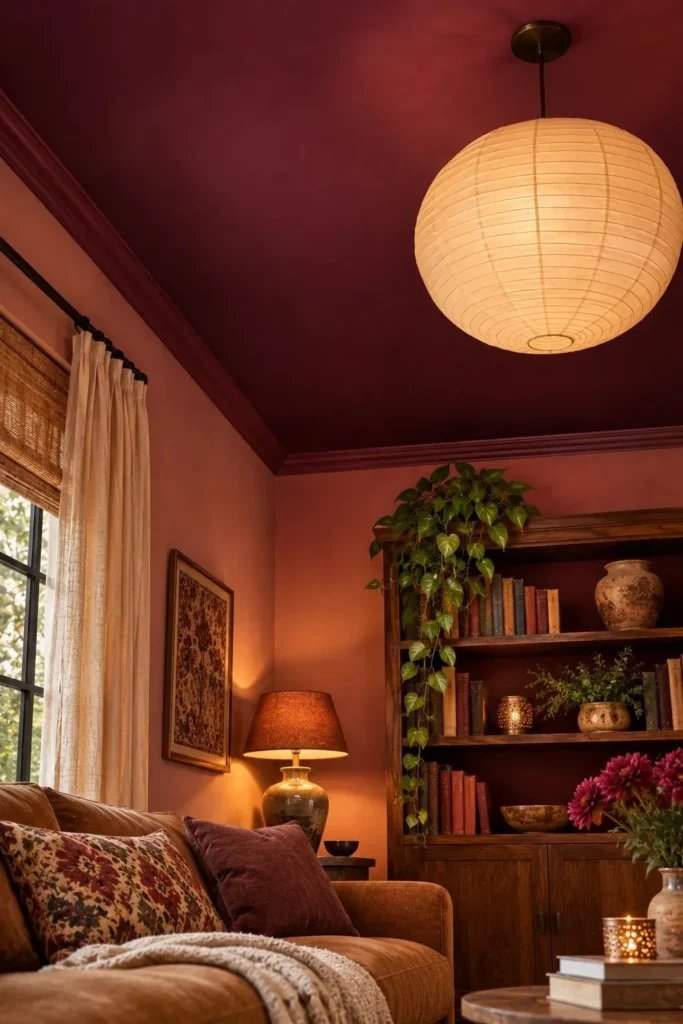
BEFORE: From the sofa, the brightest surface in the room is the white ceiling. Its sharp edge above dusty rose walls draws the eye away from the seating area.
AFTER: An aubergine ceiling carries the warmth of the walls overhead. Against the deep plum, a cream paper lantern stands out even before you switch it on.
Paint a sample board and hold it flat overhead while someone checks the color from the sofa. A shade that reads purple on a vertical wall can look almost brown above you. Make the final call in the evening, with the lamps you actually use turned on.
Sepia Family Photo Ledge

- Start with a photograph you’d enjoy telling a guest about. A candid scene with a familiar face often earns the central spot.
- Choose two companion images with different crops, such as a close portrait and a wider street scene. Make sepia copies and keep the originals intact.
- Arrange the frames on a table first. Overlap one pair slightly, keeping faces and handwritten captions in view.
- Check the deepest frame against the ledge before mounting it. Its base should sit flat behind the front lip.
A little handwriting can hold more meaning than a matching frame set. If a photograph has a date or a name penciled on the back, copy that detail too. Slip the small copy inside the mat beneath the image so visitors can read it without picking up the frame.
Folding Woven Screen
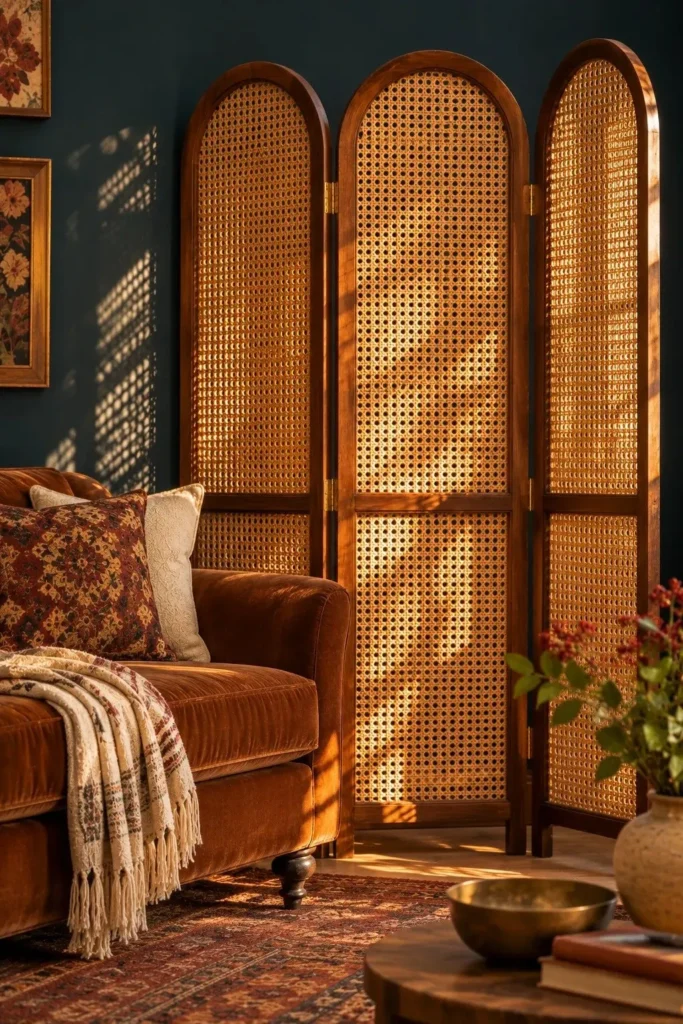
| Design detail | Open cane lattice | Tightly woven rush |
|---|---|---|
| View through the screen | A glimpse of the room beyond keeps a small seating area feeling open. | Dense panels hide a desk and its tangle of cords. |
| Effect near a window | Sunlight casts a pattern through the gaps. | Light grazes the surface and picks out the woven ridges. |
| Best position | Beside a reading chair that still needs daylight. | Behind a sofa that shares its space with a work area. |
A folding screen needs more floor space than its slim frame suggests. Lay three strips of painter’s tape on the floor in a shallow zigzag to mark the footprint. Walk past with a laundry basket. If you have to turn sideways, shorten the run by folding one panel farther inward.
Patterned Tile Side Table
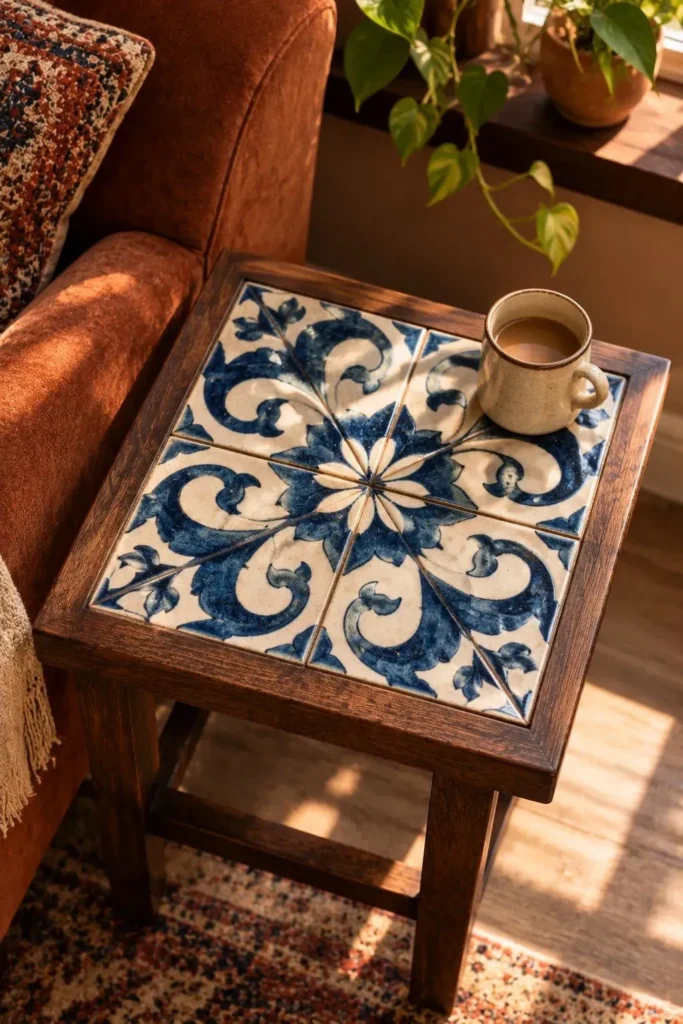
DO
- Give a four-tile pattern room to read by setting the table beside a plain sofa arm.
- Look for a flush rim so a saucer can sit level near the edge.
- Test the height from your usual seat and check that you can set down a cup comfortably.
DON’T
- Don’t cover the central motif with a lamp base.
- Don’t choose deeply recessed grout lines if you often use narrow drinking glasses.
- Don’t tuck the table so far beneath the sofa arm that half the pattern disappears.
A tile top lets you bring a crisp pattern into a dark boho living room even when the rug and upholstery are solid colors. Look closely at the tile corners before choosing a design. Four modest quarter circles can meet to form one generous flower right where you set your coffee.
Earthenware Floor Urn

Shape: Broad shoulders give an empty corner a distinct silhouette, even with the urn left empty.
Finish: Unglazed clay picks up side light along its ridges.
Filler: Two forked branches make an open arrangement that shows off the narrow mouth.
Placement: Beside a low cabinet, clear of swinging doors and curtain hems.
Choose the branches after you put the urn in place. From your usual seat, check where each fork falls against the wall. Trim the stems a little at a time until the tips sit against plain paint, where you can follow their outlines even from across the room.
Midnight Floral Wallpaper

From the doorway, a tiny floral print can read as a single wash of color. For flowers you can recognize across the room, look for a midnight ground with a few palm-sized blooms. Rust petals and olive leaves give you two colors to borrow for cushions or a rug.
Tape a full pattern repeat behind the sofa before ordering. Set the cushions back in place and see which part of the design peeks above them. If your favorite bloom disappears behind the sofa back, adjust the starting height on paper before cutting the first strip.
Tasseled Curtain Tiebacks
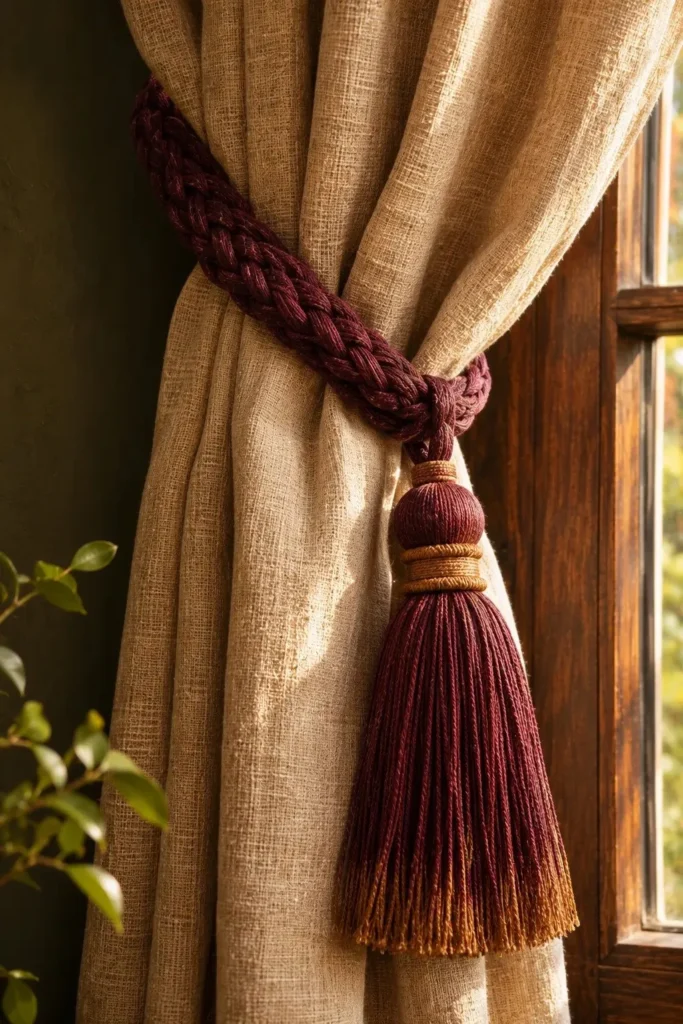
- Give plain curtains a shot of color with a plum or tobacco tassel thick enough to stand out against the fabric.
- Gather the panel loosely by hand first. Slide your hand up or down until the folds frame the part of the window you want to see.
- Loop the cord around the gathered fabric and turn the knot toward the wall so the tassel faces the room.
- Set the fringe against a broad fold. Fine threads tend to disappear when they fall into a deep crease.
Before fitting a hook, live with the tieback loosely knotted around the panel for a day. You may like a low gather that lets the upper fabric billow, or a higher one that clears the sill for plants. Mark the height once you’ve opened and closed the curtain a few times.
Canvas Sling Chair

Quick Tip:
A sling chair sits lower once you settle into it. Test the height with your feet on the floor and a book in hand, especially if you plan to pull it beside a table you already own.
Canvas brings a softer outline to a room full of boxy furniture. Set the chair at a slight angle to the sofa so its open wooden side faces the doorway. From there, you can see the sweep of the fabric and a little of the rug beneath the seat.
Vintage Blanket Trunk

BEFORE: Three blankets share one sofa arm, but the quilt you reach for on cool evenings is always at the bottom. Pull it free and the whole pile slides onto the seat.
AFTER: A low vintage trunk beside the sofa holds the blankets upright, with a different folded edge showing on each one. The indigo quilt is easy to spot and lift out with one hand.
Bring your bulkiest folded throw when you shop secondhand. Check that it fits below the rim and run your palm along the inside to feel for rough spots that could snag wool. At home, open the lid fully before settling on a wall position so the hinges have room to move.
Woven Basket Wall

- Pick one basket with a pattern you can recognize from the doorway. A bold spiral makes a clear starting point for the group.
- Trace each rim onto scrap paper and cut out the circles. Tape the largest one slightly off center above the sofa.
- Build outward with smaller circles, leaving about two fingers of wall between neighboring edges. Check the arrangement from your usual seat.
- Mark each hanging point on its paper circle, accounting for where the loop sits on the back. Remove the paper as you hang each basket.
Vary the depth as well as the diameter. A shallow tray shows off its pattern face on, while a bowl with a deeper rim casts a crescent of shadow. Put the deepest piece toward the window side of the group and watch how its outline changes through the afternoon.
Striped Sofa Slipcover

| Design detail | Narrow ticking stripe | Broad woven stripe |
|---|---|---|
| View from the doorway | Fine lines blend into a softer overall tone. | Distinct bands make the sofa the first thing you see. |
| Shape of the sofa | Small stripes follow rounded arms with subtle shifts in direction. | Wide bands show clearly across a long, straight back. |
| Rug pairing | Works beside a larger motif, such as an open diamond pattern. | Sits comfortably above plain jute or a nearly solid rug. |
Drape the sample over a sofa arm before choosing the stripe width. A swatch that lies flat can hide how sharply the lines bend around a curve. For a ready-made cover, check where the seams land on your particular sofa. A crooked stripe is easiest to spot along the front edge.
Stenciled Floor Border
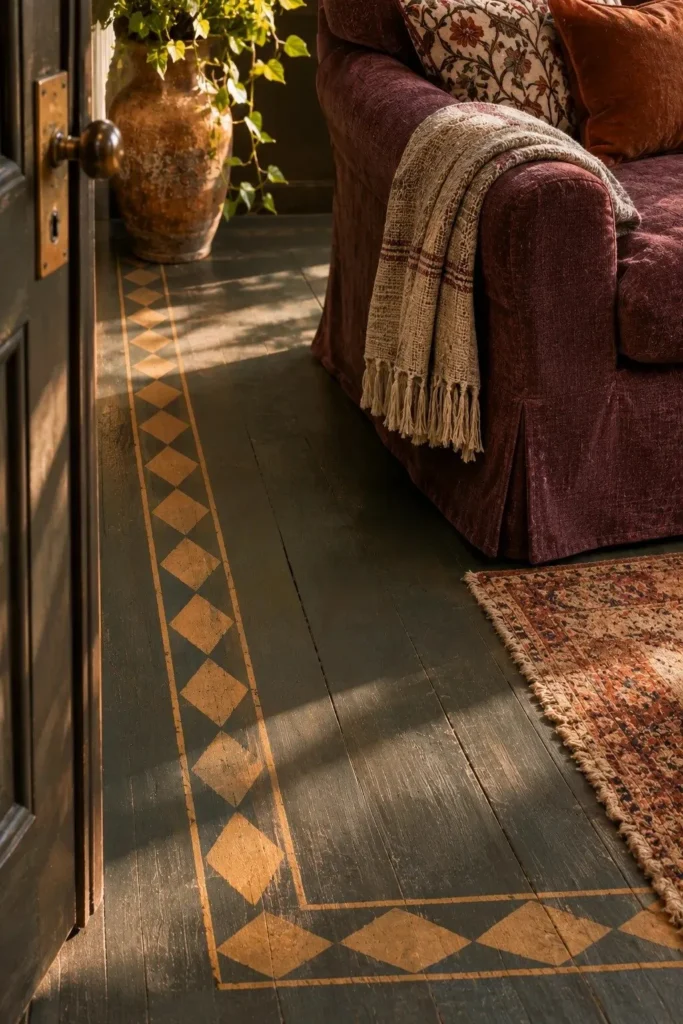
DO
- Borrow a single motif from your rug, such as a diamond, and repeat it along the edge of the room.
- Test a full row on paper. Adjust the spacing so a whole motif lands at the most visible doorway.
- Use paint intended for floors and follow its instructions for surface preparation and drying.
DON’T
- Don’t load the stencil brush heavily. Dab off excess paint on scrap paper to keep the edges crisp.
- Don’t rely on a baseboard as your only guide. Mark a straight reference line before positioning the stencil.
- Don’t put the rug back until the paint has cured for the time specified on the label.
Check the layout with the furniture in place before you open the paint. A narrow border can disappear beneath a long sofa, while a row just inside the doorway gets seen every day. In a small room, that single run of pattern may be all the floor needs.
Floor Cushion Tea Corner
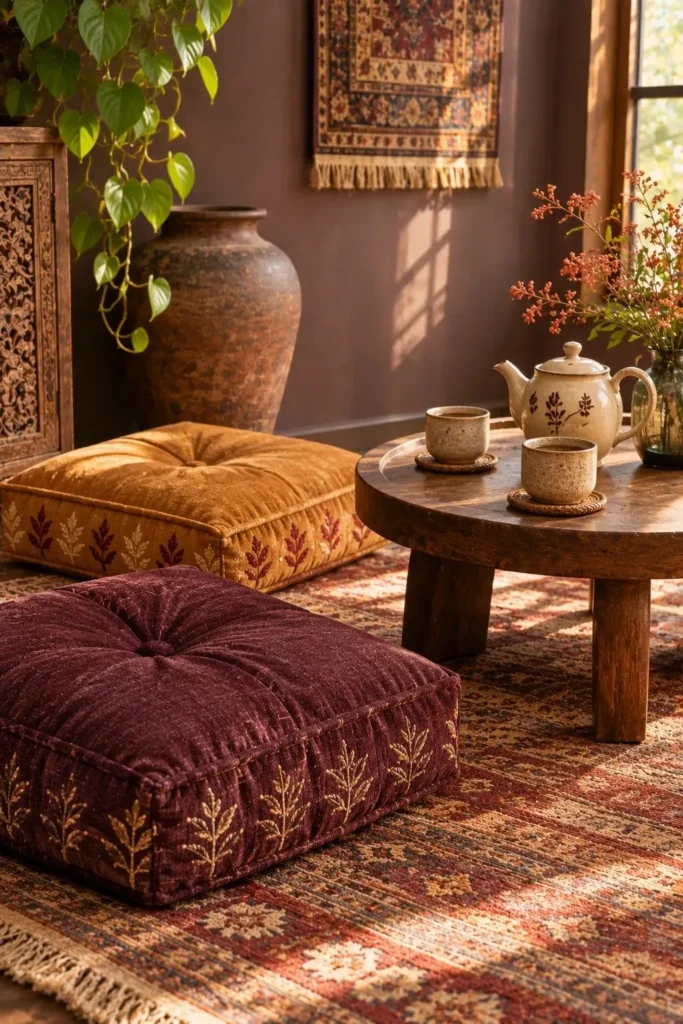
Best spot: An unused corner with enough room to stretch your legs beside the table.
Cushion choice: Firm, boxed cushions give you a more level seat than loose throw pillows.
Table height: From the cushion, check that you can lift a cup without raising your shoulder.
Small-room storage: Stack the cushions under the table between uses.
Set the cushions at a right angle so two people can talk without balancing their cups on their knees. Before bringing over a full pot, sit down and check where your feet land. A few inches between the table legs and your ankles can buy you a much slower, more comfortable cup of tea.
Conclusion
Start with one piece you’d miss if it were gone. Maybe it’s a quilt someone made for you or the record you play on quiet Sundays. Let that piece guide one choice in your dark boho living room. Hang the quilt where its stitching catches the afternoon light, or give the album cover a spot beside the turntable.
Save this post on Pinterest so you can find your favorite ideas again, and share it with a friend who loves deep colors and collected pieces. Then try one idea tonight. Give something you love a place where you’ll enjoy it every day.